You found the right house. You negotiated a strong price. Your mortgage is approved. Then you see the closing disclosure — and the number at the bottom is thousands of dollars more than you expected.
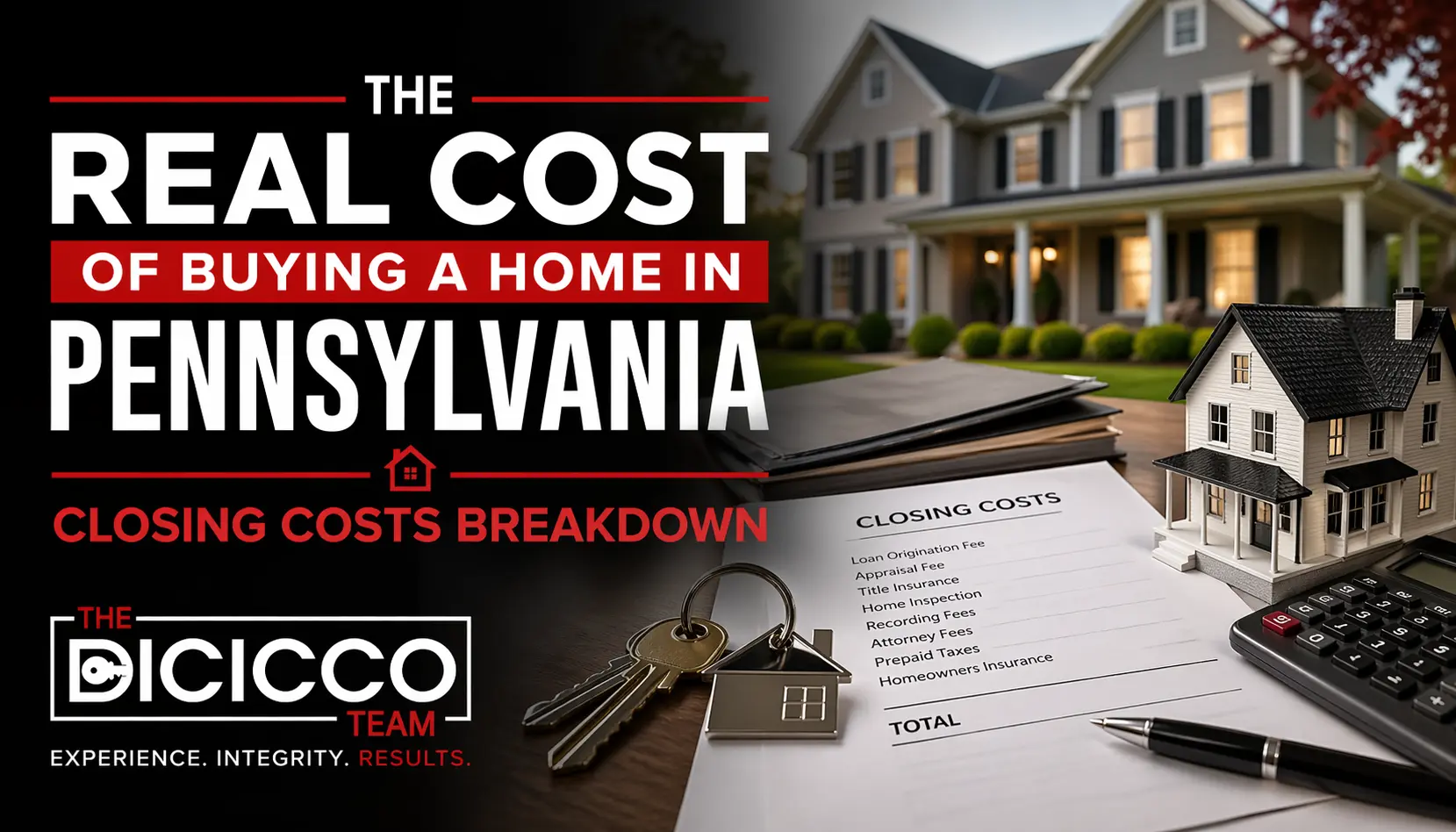
Closing costs catch Bucks County buyers off guard more often than almost anything else in the home purchase process. Many buyers budget for the down payment and assume that’s the finish line, only to discover that Pennsylvania’s transfer taxes, lender fees, title insurance, and prepaid escrow items can add up to 2% to 5% of the purchase price — on top of the down payment.
On a $475,000 home — roughly the Bucks County median — that’s an additional $9,500 to $23,750 due at the closing table.
In this guide, The DiCicco Team breaks down every closing cost Bucks County buyers can expect to pay in Pennsylvania, explains what each fee covers, and shows you where there’s room to negotiate. With 590 transactions completed and 101 sales in the past 12 months, we’ve helped hundreds of buyers walk into closing fully prepared — not blindsided.
What You’ll Learn
- What closing costs are and why they exist
- Every major closing cost Pennsylvania buyers pay — broken down by category
- What’s unique about Pennsylvania’s transfer tax structure
- Which costs are negotiable — and how to negotiate them
- How first-time buyers can reduce closing costs with PA assistance programs
- A real-dollar example based on the Bucks County median home price
- Frequently asked questions about Pennsylvania closing costs
Why Closing Costs Shock So Many Pennsylvania Home Buyers
Closing costs are fees and prepaid expenses required to finalize a home purchase. They’re collected at the settlement table — the final step before you get the keys. Unlike the purchase price itself, which buyers research extensively, closing costs often receive little attention until the lender issues a Loan Estimate early in the mortgage process or the Closing Disclosure three days before settlement.
By then, many buyers have already committed to the home, the timeline, and the moving company. There’s little room to adjust if the numbers are a surprise. Understanding the estimated closing costs in PA before making an offer can help buyers prepare their budget and avoid unexpected financial pressure.
The problem is particularly pronounced in Pennsylvania because the state has one of the higher transfer tax structures in the region. Combined with lender origination fees, title insurance, prepaid homeowners insurance, initial escrow deposits, and various government recording fees, Pennsylvania buyers can face a closing cost total that feels like a second down payment.
The DiCicco Team always walks buyers through a detailed closing cost estimate before they submit an offer — so the numbers at settlement are never a surprise.
The Real Causes: Why Pennsylvania Closing Costs Run Higher Than Expected
Cause #1: Pennsylvania’s Transfer Tax Is Higher Than Most Buyers Realize
Pennsylvania imposes a 1% state transfer tax on every real estate transaction. But that’s only the state’s portion. Each municipality in Pennsylvania also charges a local transfer tax — typically 1% as well, though it varies by community. In most Bucks County municipalities, buyers and sellers split the combined 2% total equally, meaning each party pays 1%.
On a $475,000 purchase, that’s $4,750 in transfer tax paid by the buyer alone. In some municipalities — including Philadelphia — the local transfer tax is significantly higher (Philadelphia charges 3.278% local, bringing the total to 4.278%). Buyers relocating from states like New Jersey or Delaware, where transfer taxes are lower or structured differently, are frequently caught off guard.
Cause #2: Title Insurance Is Required — and Underestimated
Pennsylvania requires title insurance as part of every mortgage transaction. There are two policies: the lender’s title insurance policy (required by your mortgage lender and paid by the buyer) and an optional owner’s title insurance policy (which protects your own equity). Most buyers purchase both.
Title insurance in Pennsylvania is regulated by the state and priced based on the purchase price. On a $475,000 purchase, expect to pay roughly $1,500 to $2,200 for the lender’s policy and a similar amount for the owner’s policy if purchased simultaneously. Buyers who skip the owner’s policy to save money take on personal risk — title defects, liens, or ownership disputes discovered after closing become entirely their problem.
Cause #3: Lender Fees Add Up Faster Than Buyers Expect
Your mortgage lender charges fees for processing and underwriting your loan. These vary significantly by lender but typically include:
- Origination fee or points (0% to 1% of the loan amount, sometimes more)
- Underwriting fee ($400 to $900)
- Application and processing fees ($300 to $700)
- Appraisal fee ($500 to $800 for a standard single-family home in Bucks County)
- Credit report fee ($25 to $75)
On a $400,000 loan, a 1% origination fee alone is $4,000. Shopping lenders — getting Loan Estimates from at least three — is one of the most effective ways buyers can reduce their total closing costs.
Cause #4: Prepaid Items and Escrow Deposits Are Closing Costs Too
Many buyers don’t realize that “closing costs” include money that isn’t a fee at all — it’s prepaid interest, insurance, and property taxes collected upfront to fund your escrow account.
At closing, Pennsylvania buyers typically pay:
- Prepaid homeowners insurance (usually 12 to 14 months upfront)
- Initial escrow deposit for property taxes (2 to 3 months of estimated annual taxes)
- Prepaid mortgage interest (interest from the closing date to the end of the month)
Bucks County property taxes vary significantly by municipality and school district. A home in the Council Rock School District might carry annual taxes of $7,000 to $10,000+. Two months of reserves alone could mean $1,400 to $2,000 collected at closing — in addition to whatever you prepay at settlement.
Complete Pennsylvania Closing Cost Breakdown
The following table reflects typical ranges for a Bucks County home purchase at $475,000 with a conventional loan. Actual costs vary by lender, municipality, and individual circumstances.
| Cost Item | Typical Range | Who Pays | Notes |
| PA State Transfer Tax (1%) | $4,750 | Buyer (half of 2%) | Split equally with seller in most Bucks County municipalities |
| Local Transfer Tax (~1%) | $4,750 | Buyer (half of 2%) | Rate varies by municipality; Phila. is much higher |
| Loan Origination Fee | $0 – $4,750 | Buyer | 0–1% of loan amount; shop multiple lenders |
| Underwriting / Processing | $700 – $1,600 | Buyer | Varies significantly by lender |
| Appraisal Fee | $500 – $800 | Buyer | Paid upfront or at closing depending on lender |
| Credit Report Fee | $25 – $75 | Buyer | Minor but included in Loan Estimate |
| Lender’s Title Insurance | $1,200 – $2,000 | Buyer | Required by lender; state-regulated rates |
| Owner’s Title Insurance | $1,000 – $1,800 | Buyer (optional) | Strongly recommended; protects buyer’s equity |
| Title Search / Exam | $200 – $500 | Buyer | Attorney or title company researches ownership history |
| Settlement / Closing Fee | $400 – $800 | Buyer and/or Seller | Paid to settlement company or attorney |
| Recording Fees | $100 – $300 | Buyer | County fee to record deed and mortgage |
| Survey (if required) | $400 – $800 | Buyer | Not always required; depends on property and lender |
| Prepaid Homeowners Insurance | $1,200 – $2,400 | Buyer | 12–14 months upfront; varies by coverage |
| Escrow Deposit – Property Tax | $1,000 – $3,000 | Buyer | 2–3 months of estimated annual taxes |
| Prepaid Mortgage Interest | $200 – $1,200 | Buyer | Interest from closing date through end of month |
| Home Inspection | $400 – $600 | Buyer | Paid before closing; essential — do not waive |
| TOTAL ESTIMATE | $17,000 – $26,000 | Primarily Buyer | Approx. 3.5%–5.5% of $475,000 purchase price |
Important: This table is a general guide. Your Closing Disclosure — issued by your lender three business days before settlement — will contain the exact, legally binding figures for your transaction.
What’s Negotiable — and How to Reduce Your Closing Costs
Negotiate Seller Concessions
In Pennsylvania, buyers can ask sellers to contribute toward closing costs as part of the purchase offer. These are called seller concessions or seller assists. Conventional loans allow seller assists up to 3% of the purchase price (for down payments under 10%) or up to 6% (for larger down payments). FHA loans allow up to 6%, and VA loans allow up to 4%.
On a $475,000 purchase, a 3% seller assist is $14,250 — enough to cover most of a buyer’s closing costs. In a balanced or buyer-favoring market, sellers may be willing to accept a slightly higher purchase price in exchange for covering closing costs, effectively rolling them into the mortgage.
In our experience across 590 transactions, we’ve helped Bucks County buyers structure offers that include seller assists — without losing the home to a competing offer. How that’s done depends entirely on current market conditions, which is why working with an experienced local agent matters.
Shop Your Lender
Lender fees — origination charges, underwriting fees, and processing fees — are negotiable and vary significantly between institutions. Getting Loan Estimates from at least three lenders (a local community bank, a regional lender, and an online lender) gives you real comparison data. Even a 0.25% reduction in origination fees on a $400,000 loan saves $1,000 at the closing table.
The DiCicco Team has relationships with trusted local lenders in Bucks County who offer competitive rates and understand the Pennsylvania transaction process. We’re happy to make introductions.
Choose Simultaneous Issuing for Title Insurance
If you purchase both the lender’s title insurance policy and an owner’s title policy at the same time — from the same title company — you typically pay a reduced simultaneous issue rate for the owner’s policy. This can save $300 to $600 compared to purchasing them separately.
Pennsylvania Down Payment and Closing Cost Assistance Programs
First-time buyers in Pennsylvania have access to several PHFA (Pennsylvania Housing Finance Agency) programs that can offset closing costs:
- K-FIT (Keystone Forgivable in 10 Years): 5% of purchase price, forgiven over 10 years. Can be used for down payment or closing costs.
- Keystone Advantage Assistance Loan: Up to $6,000 or 4% of purchase price (lesser of the two), repayable at 0% interest over 10 years.
- HOMEstead Downpayment and Closing Cost Assistance: Up to $10,000, forgiven over 5 years. Income and purchase price limits apply.
- PHFA Grant: $500 grant available with certain PHFA loan products.
Income limits apply to all programs and vary by county and household size. The DiCicco Team connects first-time buyers with lenders who specialize in PHFA products as part of our complimentary buyer consultation.
A Real-Dollar Example: Bucks County Median Home Purchase
Let’s put these numbers in context for a Bucks County buyer purchasing a $475,000 home with a 10% down payment ($47,500) and a $427,500 mortgage.
| Cost Item | Estimated Amount |
| Down Payment (10%) | $47,500 |
| State + Local Transfer Tax (buyer’s half) | $4,750 |
| Loan Origination Fee (0.5%) | $2,138 |
| Underwriting / Processing | $1,100 |
| Appraisal | $650 |
| Lender’s + Owner’s Title Insurance | $3,200 |
| Title Search, Settlement, Recording | $900 |
| Prepaid Homeowners Insurance (12 mo.) | $1,500 |
| Escrow Deposit — Property Taxes (2 mo.) | $1,400 |
| Prepaid Mortgage Interest (15 days) | $700 |
| Home Inspection | $500 |
| TOTAL CASH NEEDED TO CLOSE | ~$64,338 |
In this example, the buyer needs more than $64,000 at the closing table — $16,838 in closing costs on top of the $47,500 down payment. This is why The DiCicco Team builds closing cost estimates into every buyer consultation before our clients fall in love with a home they may not be fully prepared to buy.
Why Bucks County Buyers Choose The DiCicco Team
Understanding closing costs before you make an offer is the difference between a smooth settlement and a stressful scramble. The DiCicco Team brings two decades of experience to every buyer relationship — including 20+ years in investment properties and renovations that gives us an edge when evaluating whether a home’s condition, price, and total acquisition cost make financial sense.
Here’s what sets our buyer representation apart:
- We provide a full estimated closing cost breakdown before you submit your first offer — no surprises at settlement
- Our relationships with Bucks County lenders help buyers find competitive rates and manageable closing costs
- 590 total transactions and a 98% list-to-sale ratio mean we negotiate effectively for buyers — including seller concessions when the market allows
- We know which PHFA programs Bucks County first-time buyers qualify for and connect them with lenders who specialize in those products
- 5-star ratings on Google (110+ reviews) and Zillow (95 reviews) reflect the trust our clients place in us at every stage of the transaction
Our clients have told us: “He lined up financing which was incredibly competitive” and that we’re “tigers fighting to get the sale finalized.” That same energy applies to making sure every buyer we represent is financially prepared — not just emotionally ready — to close.
Frequently Asked Questions About Closing Costs in Pennsylvania
How much are closing costs when buying a home in Pennsylvania?
If you’re wondering how much are closing costs in PA, Pennsylvania buyers typically pay between 2% and 5% of the purchase price in closing costs, not including the down payment. On a $475,000 Bucks County home, that’s approximately $9,500 to $23,750. The state’s 1% transfer tax, combined with local municipal transfer taxes (usually another 1%), lender fees, title insurance, and prepaid escrow deposits are the primary drivers of that total.
Who pays the transfer tax in Pennsylvania — the buyer or seller?
Pennsylvania’s combined transfer tax (state 1% + local 1% = typically 2% total) is usually split equally between buyer and seller — each pays 1%. However, the split is negotiable and can be structured differently as part of the purchase offer. In some transactions, buyers or sellers agree to absorb more than their half. Certain municipalities have higher local rates; always confirm the rate for the specific property you’re buying.
Can the seller pay my closing costs in Pennsylvania?
Yes. Sellers can contribute to a buyer’s closing costs through what’s called a seller assist or seller concession. Conventional loans allow seller assists of 3% to 6% of the purchase price depending on your down payment amount. FHA loans allow up to 6%, and VA loans allow up to 4%. Asking for a seller assist is a negotiating strategy — The DiCicco Team advises buyers on when and how to include this in an offer without losing out to competing buyers.
What is title insurance and do I need it in Pennsylvania?
Title insurance protects against ownership defects, liens, or legal claims against the property that predate your purchase. The lender’s title insurance policy is required by your mortgage company and paid by the buyer. An owner’s title insurance policy is optional but strongly recommended — it protects your own equity at a one-time cost paid at closing. In Pennsylvania, both policies are priced based on the purchase price and regulated by the state.
Are there programs to help first-time buyers with closing costs in Bucks County?
Yes. Pennsylvania’s PHFA (Pennsylvania Housing Finance Agency) offers several programs that can be used for closing costs: the K-FIT loan (5% of purchase price, forgiven over 10 years), the Keystone Advantage loan (up to $6,000 at 0% interest), and the HOMEstead program (up to $10,000 forgiven over 5 years). Income limits and purchase price caps apply. The DiCicco Team connects qualifying first-time buyers with lenders who specialize in PHFA products.
When do I find out exactly what my closing costs will be?
Your lender is required to provide a Loan Estimate within three business days of your loan application, which gives you a good-faith estimate of all costs. Three business days before your closing date, you’ll receive the Closing Disclosure — a legally binding document showing your final, exact closing costs. Pennsylvania also requires that buyers receive a HUD-1 or settlement statement at or before closing. Review both documents carefully and ask your agent or attorney to walk you through anything unclear.
Can closing costs be rolled into my mortgage in Pennsylvania?
Closing costs generally cannot be added directly to a conventional mortgage. However, buyers can sometimes negotiate a higher purchase price with the seller agreeing to cover closing costs as part of the deal — effectively financing them through the loan. PHFA assistance programs also allow second mortgages that cover closing costs, repaid separately. A lender familiar with Pennsylvania transactions can walk you through options based on your loan type and financial situation.
What’s the difference between closing costs and prepaids?
Closing costs are fees paid to third parties for services — title insurance, lender fees, recording charges, and transfer taxes. Prepaids are money you’re putting aside in advance: homeowners insurance premiums, initial property tax escrow deposits, and prepaid mortgage interest. Both appear on your Closing Disclosure and are due at settlement, but prepaids aren’t fees — they’re funds you’ll eventually draw on through your escrow account. Your total cash to close includes both.
Ready to Buy in Bucks County? Let’s Talk Numbers First.
Here’s what to take away from this guide:
- Pennsylvania closing costs typically add 2% to 5% on top of your down payment — budget for both
- The state’s transfer tax, title insurance, and lender fees are the largest line items
- Seller concessions, lender shopping, and PHFA programs can meaningfully reduce what you pay at closing
- The DiCicco Team provides a complete closing cost estimate before you make your first offer
Schedule Your Free Buyer Consultation
Contact The DiCicco Team today for a no-obligation buyer consultation. We’ll review current Bucks County market conditions, connect you with trusted lenders, walk through a realistic closing cost estimate for your target price range, and develop a strategy to get you into the right home — prepared for every dollar it takes to get there.
Call (215) 385-2006 or visit our site to get started.
Serving Bucks County, Montgomery County, and Greater Philadelphia — 590 transactions, 98% list-to-sale ratio, 5-star rated on Google and Zillow.