
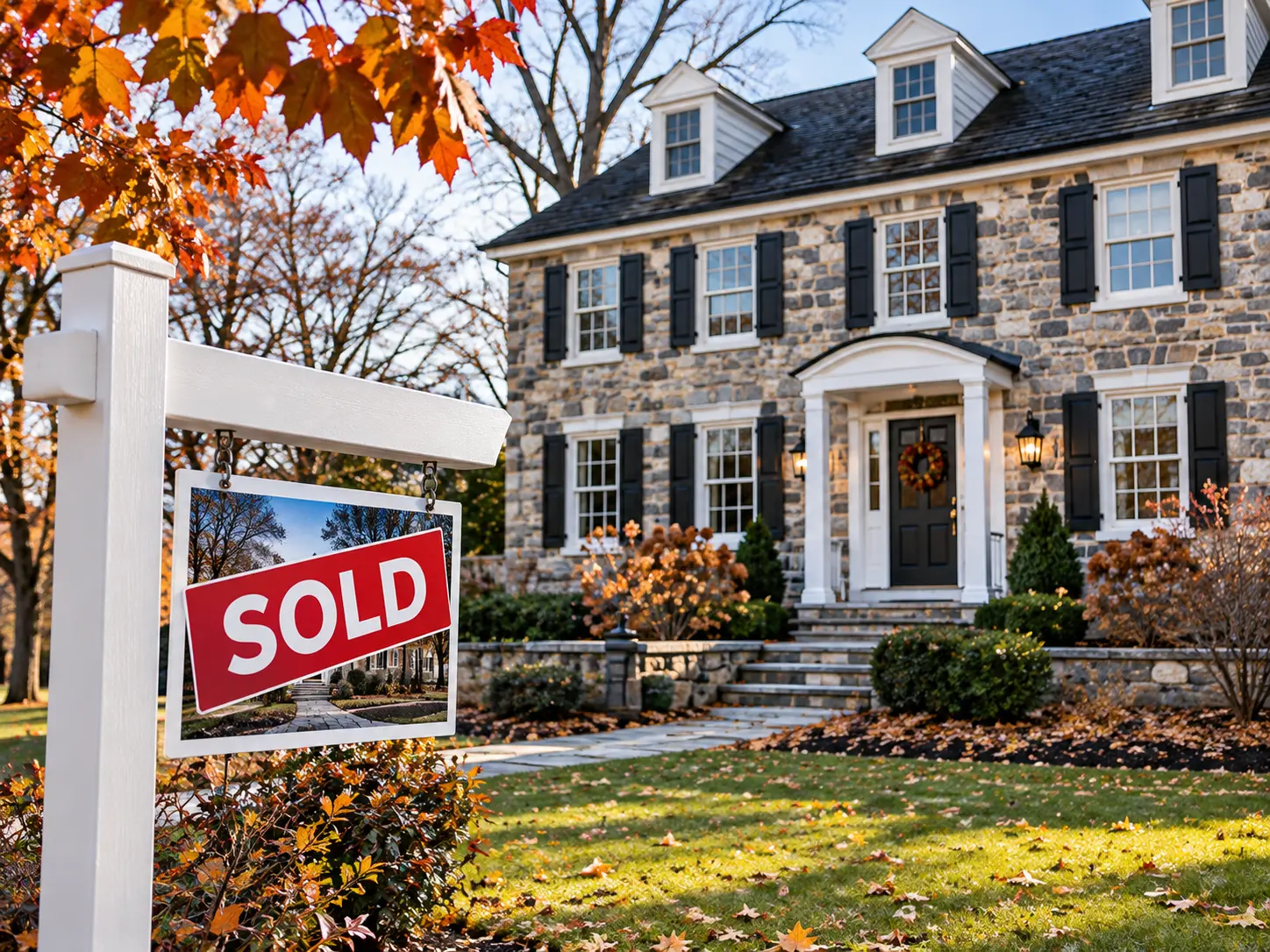
If you’re thinking about selling your Bucks County home, you’ve probably heard that you should close before the end of the year “for tax reasons.” For most homeowners, the calendar matters less than they think.
Your closing date only decides which tax year the sale lands in. What actually drives your tax bill is how long you’ve owned and lived in the home, how much profit you make, and how much other income you have that year.
That matters right now. It’s November, and a home listed today will most likely close in January. In two decades and 590 transactions, The DiCicco Team has seen sellers rush to beat December 31 and gain nothing, and others wait a few weeks and save thousands. This guide shows you which group you’re in.
Please note: Anthony DiCicco is a licensed real estate agent, not a CPA or tax attorney. This article shares general information based on 2026 IRS and Pennsylvania Department of Revenue rules. Talk with your tax professional before you decide.
What You’ll Learn
- Why year-end tax advice trips up so many sellers
- What actually drives the tax bill on a home sale
- Selling an investment property? Watch the 1031 calendar
- Selling an inherited or estate home
- How to tell which side of December 31 fits you
- Your options: sell now, list now, or prepare now
- Why Bucks County sellers choose The DiCicco Team
- Frequently asked questions
- Next steps
Why Year-End Tax Advice Trips Up So Many Sellers
Year-end advice spreads fast. A neighbor in Newtown sold in December and swears it saved money. A coworker in Richboro waited until January and says that was smarter. Both can be right, because their situations were different.
The risk is acting on someone else’s situation. Some sellers rush a listing, skip preparation, and accept a weaker offer to hit a date that never mattered for them. Others wait until spring over a tax worry that doesn’t apply.
With Bucks County’s median sale price at about $528,000 over the three months ending in August 2026 (Redfin), many long-time owners are sitting on large gains. Timing mistakes are expensive.
What Actually Drives the Tax Bill on a Home Sale
Your closing date sets the tax year. For tax purposes, your sale date is the closing date on the Form 1099-S you receive at settlement. Close on December 30, and the sale goes on your 2026 return. Close on January 4, and it goes on your 2027 return. That’s the only thing December 31 changes.
The two-out-of-five-year rule matters more than the calendar. Federal law lets you exclude up to $250,000 of profit, or $500,000 for married couples filing jointly, when you sell your main home. You must have owned it and lived in it as your main home for at least two of the five years before the sale. The two years don’t have to be in a row.
This is where timing really pays. Say you bought a Yardley townhome in February 2025. A December 2026 closing falls short of two years, so your profit could be taxable. Close after February 2027, and the full exclusion may apply. Partial exclusions exist for some job, health, and unforeseen moves.
Your income in the year you sell. Profit above the exclusion is taxed as a long-term capital gain if you owned the home more than a year. For 2026, joint filers pay 0% while taxable income stays under $98,900, 15% up to $613,700, and 20% above that. Single filers hit those limits at $49,450 and $545,500.
A large gain can also trigger the 3.8% net investment income tax for higher earners and shrink the expanded state and local tax deduction, which phases down above $505,000 of income in 2026. So ask: which year will your income be lower? Retiring, changing jobs, or a big bonus can tip the answer.
Pennsylvania plays by its own rules. Pennsylvania is more generous than the IRS. If you meet the two-out-of-five-year test, the state excludes your entire gain, with no dollar cap. If you don’t, the gain is taxed at Pennsylvania’s flat 3.07% rate.
Realty transfer tax doesn’t care about the calendar. In Bucks County it totals 2% (1% to the state, 1% split between your municipality and school district), and buyers and sellers usually split it. On a $528,000 sale, the seller’s half is about $5,280. It counts as a selling expense, which lowers your taxable gain.
Property taxes are also split by the day at settlement. If you itemize, your share is deductible in the year of sale.
A simple example: A single seller in Lower Makefield bought her home for $300,000, spent $40,000 on a new roof and kitchen remodel, and sells for $650,000 with about $45,000 in selling costs. Her gain is $265,000. The first $250,000 is excluded, leaving $15,000 taxable federally, roughly $2,250 at the 15% rate. A married couple filing jointly would likely owe nothing, and Pennsylvania taxes neither.
Selling an Investment Property? Watch the 1031 Calendar
Rentals don’t get the home sale exclusion, but a 1031 exchange can defer the tax when you buy another investment property. You have 45 days after closing to identify replacement properties in writing, and you must close within 180 days or by your tax return due date, whichever comes first.
That second deadline catches fourth-quarter sellers. Close on a rental after mid-October 2026, and day 180 falls after April 15, 2027, so you’ll need a tax extension to keep the full window. Line up a qualified intermediary before your sale closes, not after.
Selling an Inherited or Estate Home
Inherited homes follow different rules. The heir’s cost basis usually steps up to the home’s value on the date of death, so a sale soon after often produces little taxable gain. Inherited property also counts as long-term no matter how quickly it sells.
The deadline that matters isn’t December 31. It’s Pennsylvania inheritance tax, due nine months after death: 0% for a surviving spouse, 4.5% for children and other lineal heirs, 12% for siblings, and 15% for most others. Paying within three months earns a 5% discount. Order a date-of-death appraisal early and coordinate timing with the estate attorney. Our team handles estate and probate sales from Langhorne to Huntingdon Valley.
How to Tell Which Side of December 31 Fits You
A 2026 closing may make sense if:
- You’ve lived there more than two years and your gain is under the exclusion
- Your 2026 income is lower than you expect 2027 to be
- You’re already under contract or have a buyer who can close fast
Waiting until 2027 may make sense if:
- You’ll pass the two-year mark in early 2027
- You’re retiring or expect lower income next year
- Your gain is well above the exclusion
- You’re selling a rental and want the full 1031 window
Your Options: Sell Now, List Now, or Prepare Now
Push for a 2026 closing. Be realistic. Most financed purchases we handle take about 30 to 45 days from signed agreement to closing, and Bucks County homes are averaging about 27 days on market. A home listed in mid-November needs an agreement almost right away. It can happen, but never give up price or terms to beat the calendar. One price cut can erase the tax savings.
List now, close in January. This is often the best of both worlds. Winter buyers are serious buyers, and you’ll face less competing inventory in places like Doylestown and Warrington. You sell in today’s market, and the gain moves to your 2027 tax year.
Prepare now, list in spring. If the two-year rule or a 1031 plan says wait, use the time well. Find your original settlement sheet and receipts for roofs, windows, additions, and kitchens, since improvements raise your cost basis and lower your gain. Anthony’s construction background helps here. We’ll walk your home, point out which updates are worth making, and help you gather the records your CPA needs.
Every path starts with a realistic sale price. We’ll give you that number. Your CPA can turn it into your estimated tax.
Why Bucks County Sellers Choose The DiCicco Team
Pricing and negotiation decide how much profit you have in the first place. Our team holds a 98% list-to-sale price ratio across 590 career transactions, with 101 sales in the last 12 months. Anthony brings two decades of real estate experience, including 20+ years in investment properties, renovations, and custom construction, and is recognized among the top 1% of Pennsylvania Realtors.
Our 110+ five-star Google reviews and 95 Zillow reviews say the same things: responsive, knowledgeable, and honest. As one client put it, Anthony “doesn’t sugar coat a thing.” If the honest answer is “wait until February,” that’s what you’ll hear from us.
Frequently Asked Questions
Do I have to pay taxes when I sell my house in Pennsylvania?
Many sellers don’t. If you owned and lived in the home for two of the last five years, federal law excludes up to $250,000 of profit ($500,000 for joint filers), and Pennsylvania excludes the full gain. You’ll still pay your share of the realty transfer tax at closing, usually 1% of the price in Bucks County.
Does closing on December 31 instead of January 2 really make a difference?
Only in which tax year the sale is reported. If your entire gain is excluded, the date usually doesn’t change what you owe. It matters when you have a taxable gain and your income will be meaningfully different in 2026 versus 2027, or when you’re close to the two-year ownership mark.
If I list my Bucks County home now, can I close before the end of the year?
It’s possible but tight. Bucks County homes are averaging about 27 days on market, and financed closings usually take 30 to 45 days after an agreement. A December closing typically needs sharp pricing, strong presentation, and a buyer who can close quickly. Most homes listed in November close in January.
What if I haven’t lived in my home for two full years?
You may owe tax on the gain at the federal level and at Pennsylvania’s 3.07% rate. Check the date you’ll reach two years, because waiting until after that date can make the full exclusion available. If you’re moving for work, health, or another unforeseen reason, you may qualify for a partial exclusion.
Do I pay capital gains tax when I sell an inherited house in Pennsylvania?
Often very little. Your cost basis generally steps up to the home’s value at the date of death, so you’re taxed only on growth after that date. Separately, Pennsylvania inheritance tax applies at 0% to 15% depending on the heir and is due nine months after death.
How much is the realty transfer tax when selling a house in Bucks County?
The total is 2% of the property’s value: 1% to Pennsylvania and 1% shared by the municipality and school district. Buyers and sellers usually split it, so a seller typically pays about 1%. We confirm the exact amount for your property before you list, since the taxable value isn’t always the sale price.
Is Congress getting rid of the capital gains tax on home sales?
Several bills, including the No Tax on Home Sales Act, have been introduced to remove or raise the federal exclusion caps. As of this writing, none has passed, and the $250,000 and $500,000 limits still apply. We don’t recommend timing a sale around a bill that may never become law.
Next Steps
Here’s what to remember:
- Your closing date only decides which tax year the sale counts in
- The two-out-of-five-year rule usually matters more than December 31
- Pennsylvania excludes the full gain on a qualifying main home
- Investors and estates have deadlines that don’t follow the calendar year
Call The DiCicco Team at (215) 385-2006 or visit diciccosells.com/contact for a free, no-obligation home valuation. We’ll give you a realistic price and timeline for your Newtown, Doylestown, New Hope, or Yardley home, so you and your CPA can decide with real numbers. We serve all of Bucks County, Montgomery County, and Greater Philadelphia.
About Anthony DiCicco
Anthony DiCicco leads The DiCicco Team at Keller Williams Newtown. His career started more than 20 years ago in investment properties, renovations, and custom home construction, which gives him insight into property value and condition that most agents don’t have.
Licensed in Pennsylvania (RS315362) and recognized among the top 1% of Pennsylvania Realtors, Anthony and his team have helped more than 500 families buy and sell, completing 590 transactions totaling more than $200 million. He’s a Zillow Premier Agent with five-star ratings on Google and Zillow. Reach Anthony at (215) 385-2006 or anthony@diciccosells.com.